40 / 55

Differences that change the conversation

My schedule, your problem

Autonomia a zależności operacyjne

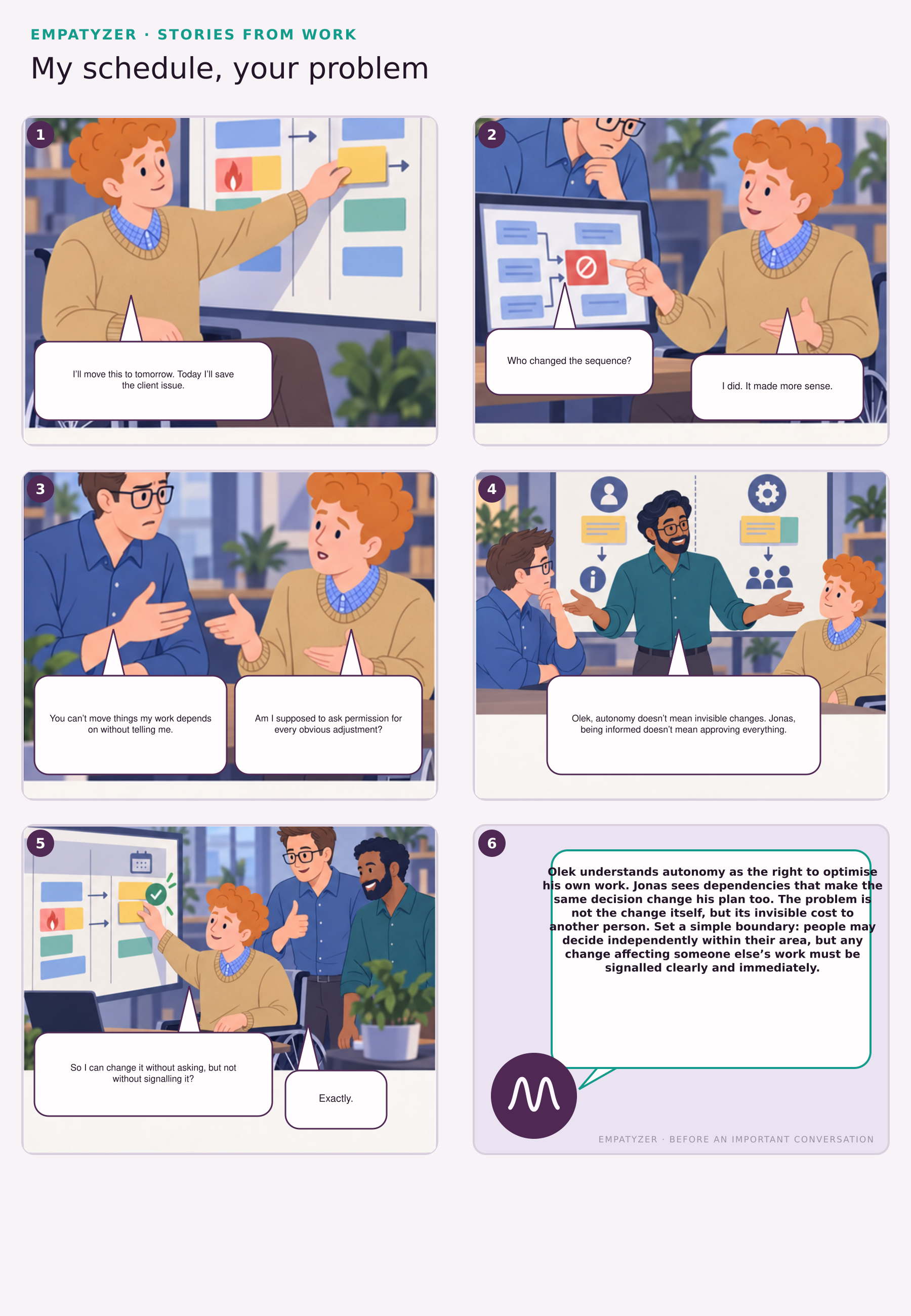
Olek changes his schedule flexibly, but Jonas only finds out when it blocks his work. Personal autonomy can create a cost for someone else.
Download the full comicPNGSVGPPTX
Olek, Jonas, Karim in panel 1 of My schedule, your problem.
I’ll move this to tomorrow. Today I’ll save the client issue.

Olek, Jonas, Karim in panel 2 of My schedule, your problem.
Who changed the sequence?
I did. It made more sense.

Olek, Jonas, Karim in panel 3 of My schedule, your problem.
You can’t move things my work depends on without telling me.
Am I supposed to ask permission for every obvious adjustment?

Olek, Jonas, Karim in panel 4 of My schedule, your problem.
Olek, autonomy doesn’t mean invisible changes. Jonas, being informed doesn’t mean approving everything.

Olek, Jonas, Karim in panel 5 of My schedule, your problem.
So I can change it without asking, but not without signalling it?
Exactly.

Em, the Empatyzer coach
Olek understands autonomy as the right to optimise his own work. Jonas sees dependencies that make the same decision change his plan too. The problem is not the change itself, but its invisible cost to another person. Set a simple boundary: people may decide independently within their area, but any change affecting someone else’s work must be signalled clearly and immediately.